
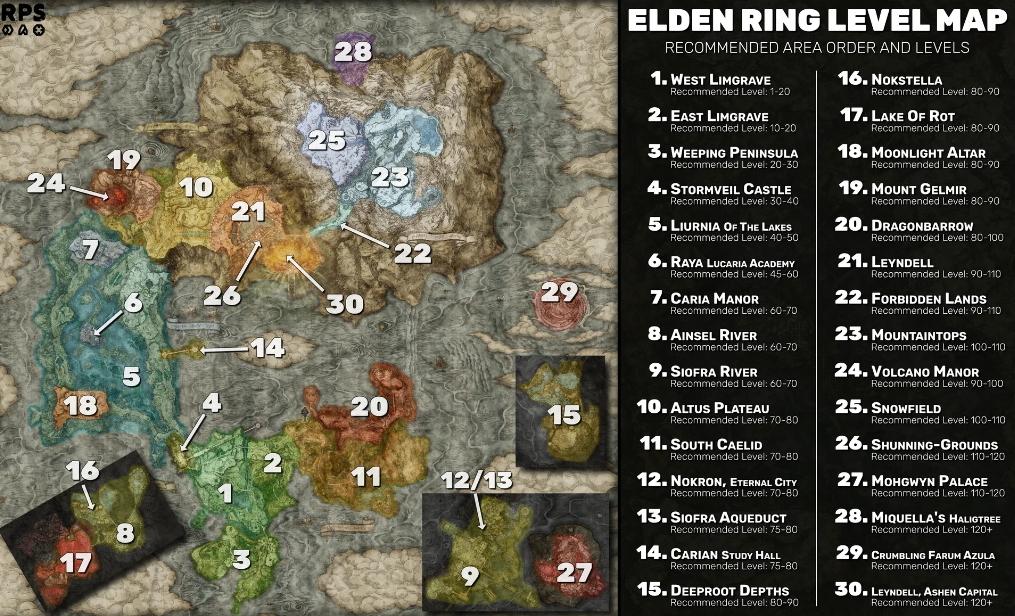
Quick Answer: The Elden Ring world map covers six major surface regions (Limgrave, Liurnia, Caelid, Altus Plateau, Mountaintops, Mt. Gelmir) plus underground areas (Siofra, Ainsel, Mohgwyn) and the DLC Land of Shadow. Each region has a Map Fragment that reveals its layout. Sites of Grace are checkpoints and the gold trail at major Sites points toward the main story.
The Lands Between is one of the largest and most intricate open worlds ever built, and learning to explore it well is the difference between a frustrating playthrough and an unforgettable one. This guide breaks down how the map works, how to uncover it efficiently, and how to make sure you never miss the treasures, dungeons, and secrets that make Elden Ring special.
How the Map Is Structured
Elden Ring’s world is divided into large, distinct regions, each with its own theme, enemies, and challenges. You begin in Limgrave and gradually gain access to Liurnia of the Lakes, Caelid, the Altus Plateau, Mt. Gelmir, the Mountaintops of the Giants, and several hidden areas beyond. Progression is loosely gated — you can wander far early, but each region is tuned for a rough power level.
Crucially, the world is also layered vertically. Beneath the surface lies an entire underground network — vast subterranean regions like the Siofra River and Ainsel River that rival the surface in size. Many players miss these areas entirely, so always keep an eye out for wells and elevators leading down.
Find the Map Fragments First
When you enter a new region, your map for that area starts blank. Each region has a Map Fragment — a stele marked by a distinctive glowing pillar icon on your map. Picking it up reveals the full layout of that region, including points of interest.
Making the Map Fragment your first goal in any new area is the single best exploration habit you can build. A revealed map shows you the lay of the land, helps you spot dungeons, and turns aimless wandering into purposeful adventuring.
Sites of Grace and Golden Guidance
Sites of Grace are your checkpoints, fast-travel points, and level-up stations. They also serve as a subtle navigation system. At certain Sites of Grace, you will see a faint trail of golden light pointing in a direction — this is the game’s guidance toward the next major story objective.
The guidance is optional. You are free to ignore it and explore in any direction. But when you feel genuinely lost about where the critical path leads, following the gold will set you back on track. Our complete beginner’s guide covers how Sites of Grace tie into overall progression.
Stakes of Marika
Near many dangerous areas and bosses, you will find a Stake of Marika — a glowing item you can touch. Stakes act as respawn points: if you die in a nearby fight, you can choose to revive at the Stake instead of the last Site of Grace. Touching every Stake you pass saves enormous amounts of backtracking, especially before tough boss arenas.
Legacy Dungeons vs. the Open World
Elden Ring’s content comes in two main flavors. The open world is the connective tissue — fields, ruins, caves, and roaming enemies you explore freely on horseback. Legacy Dungeons are the huge, handcrafted, interconnected zones like Stormveil Castle and Leyndell — dense, vertical, and packed with enemies, secrets, and a major boss at the end.
Both reward exploration, but Legacy Dungeons especially repay careful, methodical play. Take your time, check every side path, and look up — Elden Ring loves hiding routes above and below the obvious one.
Minor Dungeons: Caves, Catacombs, and Tunnels
Scattered across every region are smaller dungeons, each with a particular focus:
- Caves and Grottoes: often contain crafting materials, talismans, and useful gear;
- Catacombs: tomb-like dungeons that usually end with a boss guarding a Spirit Ash summon;
- Tunnels and Mines: the primary source of Smithing Stones for upgrading your weapons.
These minor dungeons are the backbone of character progression. If you feel underpowered, clearing a few nearby dungeons will reliably provide upgrade materials and gear to close the gap.
Using the Map Effectively
The in-game map is a powerful tool when used well. Place custom markers on anything you want to return to — an unopened door, a tough enemy, a merchant, or a glowing item you could not reach. The game gives you a generous supply of markers and several marker types, so use them liberally.
When you spot an icon you do not recognize, travel toward it. Points of interest revealed by Map Fragments are almost always worth investigating.
Exploring on Torrent
Your spectral mount, Torrent, transforms exploration. He moves quickly, can perform a powerful double jump, and lets you escape dangerous enemies with ease. Torrent also enables special traversal: glowing spirit springs launch you high into the air, opening routes to otherwise unreachable ledges and cliffs.
When exploring, stay mounted in open areas for speed, and dismount for dungeons and precise platforming. Learning Torrent’s double jump is essential for reaching many hidden items.
Tips for Thorough Exploration
- Look up and down: Elden Ring constantly hides paths on cliffs above and ledges below. Train yourself to scan vertically;
- Investigate suspicious walls: some illusory walls reveal secret rooms when struck;
- Follow the edges: coastlines, cliff rims, and region borders frequently hide items and entrances;
- Read item descriptions: they often hint at locations of related gear and lore;
- Return later: note areas that are too tough now and come back when stronger.
What to Prioritize While Exploring
With so much to see, focus your exploration on what makes you stronger:
- Golden Seeds and Sacred Tears to upgrade your healing flask;
- Smithing Stones from tunnels to upgrade your weapon;
- Talismans that boost your build;
- Spirit Ashes for summoning help in tough fights.
Chasing these rewards naturally pulls you through the world’s best content while keeping your character on pace.
Frequently Asked Questions
How big is the Elden Ring map?
The surface alone spans several massive regions, and the underground areas add an entire second layer nearly as large. A thorough first playthrough easily takes dozens of hours.
Should I follow the golden guidance?
Only when you want to. It points toward the main story path, but Elden Ring is designed to reward free exploration. Use it as a fallback when you feel lost.
What is the first thing I should do in a new region?
Find the Map Fragment. A revealed map turns blind wandering into efficient, rewarding exploration.
Final Thoughts
Exploration is the heart of Elden Ring. Grab each region’s Map Fragment, touch every Site of Grace and Stake of Marika, clear the minor dungeons for upgrades, and never stop looking up and down. The Lands Between rewards curiosity more than almost any other game — and the more thoroughly you explore, the stronger and more prepared you will be for whatever lies ahead.
Join the Tarnished
Get new Elden Ring builds, guides, and wiki updates delivered straight to your inbox.
Frequently Asked Questions
Q: How do I uncover the Elden Ring map?
A: Each region has a Map Fragment marked with a glowing pillar icon. Pick it up to reveal that region’s full map including points of interest.
Q: Where is Map Fragment in Limgrave?
A: The Limgrave Map Fragment is on the central road heading north, on a glowing stele next to a wagon. Visible from the Stranded Graveyard exit.
Q: What are Sites of Grace?
A: Sites of Grace are checkpoints that restore HP/FP, refill flasks, respawn enemies, and serve as fast-travel points. The golden light trail points toward main story progression.